How The Second Mississippi Infantry Regiment began
In the opening months of 1861, the 2nd Mississippi Infantry was not yet a regiment. It was a scattering of independent volunteer companies, raised in the towns and rural communities of northeastern Mississippi, and each had its own name, its own officers, and its own local identity, as every creek keeps its own bed until it meets the river. Some of the companies had entered state service weeks before they assembled to form a regiment. Others were still completing their organization as the spring progressed. Together these men would become the 2nd Mississippi Infantry Volunteers, a regiment that served nearly four years in the Army of Northern Virginia.
On the county map of 1861, northeastern Mississippi consisted of four principal counties: Tishomingo, Tippah, Itawamba, and Pontotoc. The region looked considerably different then than it does today, since several present-day counties, including Alcorn, Prentiss, Lee, Union, and Benton, would later be formed from portions of this territory. Following Mississippi's secession from the Union, local volunteer companies began enrolling men in February and March 1861, and recruitment continued into April. The companies reflected the communities from which they came, and their names were often as distinctive as their local origins.
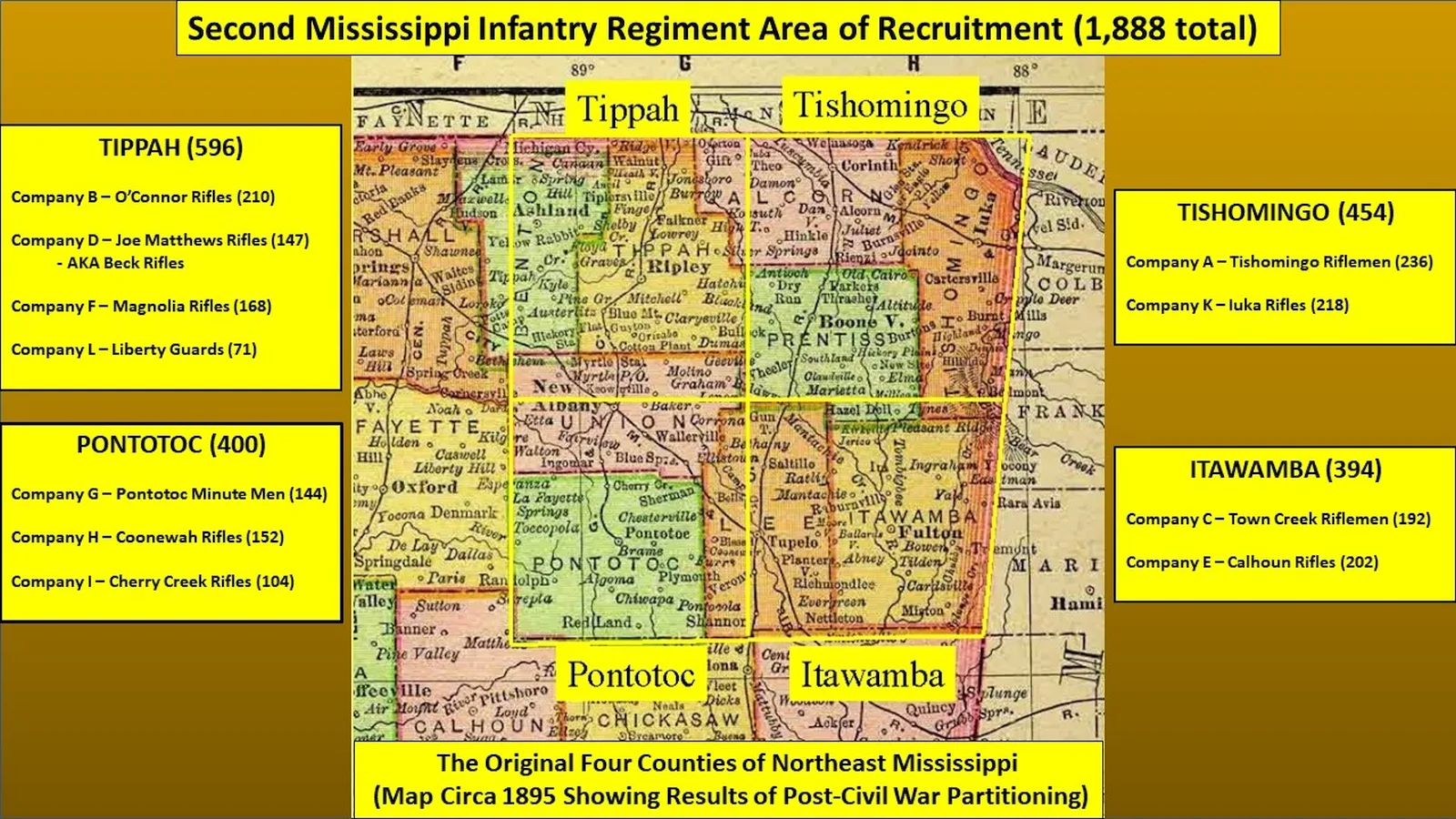
Recruitment areas of the 2nd Mississippi Infantry, showing the four original northeastern Mississippi counties and the companies they furnished. Includes Company L, added in 1862. Map by Michael R. Brasher, based on a circa 1895 county map.
Tishomingo County furnished two of the ten companies: the Tishomingo Riflemen, who entered state service at Corinth on February 20th, and the Iuka Rifles, who mustered at Iuka on April 6th. Itawamba County furnished the Calhoun Rifles, mustered into state service on February 18th, and the Town Creek Riflemen, who entered service at Verona on February 27th. Tippah County provided the O'Connor Rifles, the Joe Matthews Rifles (also known as the Beck Rifles), and the Magnolia Rifles. Pontotoc County furnished the Pontotoc Minute Men, the Coonewah Rifles, and the Cherry Creek Rifles, the Coonewah Rifles entering state service at Chesterville on March 1st. Together these ten companies would form the original 2nd Mississippi Infantry Regiment.
The O'Connor Rifles, organized in Tippah County, were presented a flag by Mrs. Judge Green, and the company marched to Saulsbury, Tennessee, where its men boarded a train for Corinth. The Magnolia Rifles, also of Tippah County, received a flag from Mrs. W. R. Cole on April 30, 1861. Such notices are worth having because relatively little firsthand material survives from the regiment's earliest days. Unlike some better-documented Confederate regiments, the 2nd Mississippi left comparatively few narratives written by its own members, and its history must frequently be reconstructed from official documents, individual service records, and scattered references in the records of other commands. Even these brief accounts of company movements and flag presentations restore something of the local character the companies had before they were a regiment.
By early May 1861, the companies had assembled at Corinth, Mississippi, an important railroad junction in the northeastern corner of the state. Their initial state organization placed them within the 2nd Regiment of Mott's Brigade, State Army of Mississippi. On May 3, 1861, the ten companies were formally organized into the 2nd Mississippi Infantry Regiment, with the election of regimental officers. The original organization consisted of ten companies, the customary number for an infantry regiment.
The independent companies received the letter designations by which they would subsequently be identified in Confederate military records: Company A, the Tishomingo Riflemen; Company B, the O'Connor Rifles; Company C, the Town Creek Riflemen; Company D, the Joe Matthews Rifles; Company E, the Calhoun Rifles; Company F, the Magnolia Rifles; Company G, the Pontotoc Minute Men; Company H, the Coonewah Rifles; Company I, the Cherry Creek Rifles; and Company K, the Iuka Rifles. Readers unfamiliar with nineteenth-century military organization may look for a Company J and wonder what became of it (nothing did; the letter was traditionally skipped in the designation of military companies, so the gap is the tradition's and not the records').
An eleventh company, the Liberty Guards of Tippah County, would be organized on March 5, 1862, and join the regiment at Fredericksburg on April 6th, receiving the designation Company L. That addition was almost a year off, however, and for now the 2nd Mississippi consisted of the ten companies assembled at Corinth. The formation at Corinth was only the beginning of the regiment's organization for Confederate service.
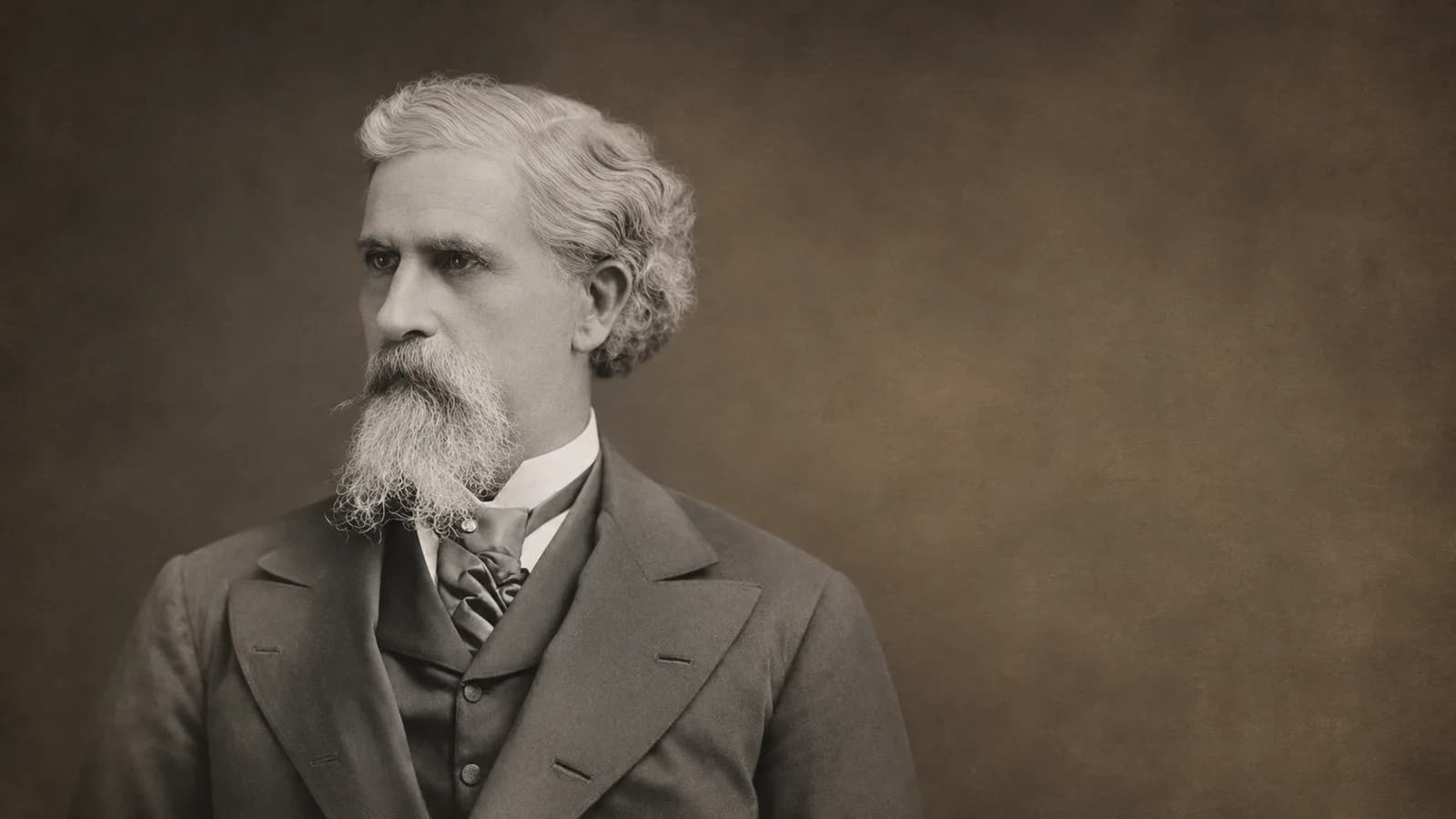
On May 10, 1861, one week after the election of its regimental officers - William Clark Falkner elected its first colonel (pictured at the top of the article) - the 2nd Mississippi Infantry Regiment was mustered into Confederate service at Lynchburg, Virginia. Men who had enrolled in local volunteer companies were now members of a Confederate infantry regiment, preparing for service far from the Mississippi communities where they had enlisted. The regiment would eventually take part in most of the major campaigns and battles fought by the Army of Northern Virginia, although it was detached from that army during the battles of Fredericksburg and Chancellorsville. Its service continued until April 2, 1865, when it was overwhelmed during the Federal breakthrough of the Petersburg defenses near Hatcher's Run. Lee surrendered at Appomattox only a week later.
Notes on Sources
This account draws principally on the Compiled Military Service Records of Confederate Soldiers who served in the 2nd Mississippi, National Archives Microfilm Publication M268, rolls 111-123 (Washington, D.C.: National Archives and Record Service, 1959), hereafter CMSR, and on Dunbar Rowland's Military History of Mississippi (Spartanburg, 1978). For the organization of the regiment and its companies I have followed Rowland, pages 40-43, checked against the CMSR. For the individual dates of entry into state service, the organization at Corinth, and the muster at Lynchburg, I have named the two works rather than assign each date to a page I have not verified. The reader should know, too, where the record runs thin. Few narratives by the regiment's own members survive, and that is why the small company-level notices, the flag presentations to the O'Connor Rifles and the Magnolia Rifles among them, have to carry more weight than they would for a better-documented regiment.
Company L, the eleventh company, complicates any attempt to analyze a specific regimental action, and the point is worth settling now. The standard formation for a regiment's companies in a battle line was two ranks to a company, and viewed from the rear of the regiment, left to right, the ten original companies stood B, G, K, E, H, C, I, D, F, A. Following the same logic, the addition of Company L produces B, G, K, E, H, C, I, D, L, F, A, and I assume that Company L normally stood with the right wing, between Companies D and F. It is an assumption. The standard alignment was only that, and the seniority of the company captains and other circumstances could shuffle the order.
Behind the narrative lies a good deal of unglamorous work: thousands of entries in the Compiled Military Service Records examined one at a time, duplicate names and aliases sorted out, and the occasional error in the original military records corrected. The results are gathered in my published annotated roster, The Second Mississippi Infantry Regiment: An Introduction to the Full Annotated Roster (Vol. 1), which attempts to bring those scattered records together and preserve the identities and service histories of the men who belonged to the regiment.
What interests me most about the 2nd Mississippi is not simply the record of where it fought, but the men who composed it. The regiment brought together volunteers from four neighboring counties, yet their backgrounds, occupations, ages, and even places of birth were more varied than one might initially suppose. In future articles I will take up some of what those records reveal about the regiment, its soldiers, and their experiences during the war.
Michael R. Brasher is the author of an annotated roster of the 2nd Mississippi Infantry Regiment. This article is adapted from his introductory research.